Products
Use cases
Industries
Resources
Company


The cross-examination of a witness at trial is the opportunity for the dramatic “gotcha” moments of prior conflicting testimony from a deposition. This article provides an overview for the legal requirements for preparing video excerpts for impeachment and how to use video excerpts in Trial Director.
It’s every lawyer's dream to play Hollywood’s Perry Mason when cross examining a witness. So we spend hours preparing for a deposition, identifying key exhibits, and deposing the witness. In preparing for trial, cross-examination outlines are prepared with key excerpts from deposition at the ready for impeachment.
The reason for all of the prep work? In case the witness at trial says something inconsistent with their deposition testimony. There is power in showing a witness who took an oath can’t keep their story straight.
Impeaching a witness with a deposition transcript packs a punch, but playing video showing them stating the opposite of what they just said in open court can be devastating to a witness’s credibility.
Video deposition testimony must be used for the purpose of impeachment; a party just can’t play excerpts from a deposition without reason. The rules for using video depositions are defined in the Rules of Evidence and Civil Procedure. State and federal rules can vary, but there are consistencies across the country.
By way of example, California’s rules state that a party may use a deposition “for the purpose of contradicting or impeaching the testimony of the deponent as a witness…” Cal. Civ. Proc. Code § 2025.620(a), which also includes, “...for any other purpose permitted by the Evidence Code.” Moreover, prior testimony can be used for impeaching or refreshing a witness’s memory, but it cannot be used to prove the truth of the matter asserted. People v. Vassar, 207 Cal. App. 2d 318, 330 (1962).
Depositions are conducted for discovery and to preserve a witness’s testimony. Berroteran v. Superior Court, 12 Cal. 5th 867, 892, (2022) [Citations omitted]. It is long-settled law that transcripts must be certified, and if there is an inconsistency, the witness must be given an opportunity to explain the inconsistency during cross-examination or redirect examination. People v. Hawley, 111 Cal. 78, 88, 43 P. 404, 406 (1896).
Depositions empower lawyers to “obtain information from the witness and to provide a foundation for the witness's impeachment if necessary, at trial.” Id., [Citations omitted]. Moreover, a transcript with sworn testimony can be used to attack a witness’s veracity for truthfulness if they deviate from prior testimony while on the witness stand.
As much as lawyers want to play the hero at trial, lawyers cannot just play cowboy firing off video clips without a plan. Here are examples of the notice requirements for using video deposition excerpts at trial:
Cal Code Civ Proc § 2025.340(m).
An associate attorney summarized a deposition transcript where a question was asked and the deponent answered, “no.” Upon watching the video of that testimony, at the moment the question was asked, the witness turned bright red, and through grit teeth, answered, “no.”
That kind of video testimony is a golden ticket for cross-examination at trial, because the deponent’s body language looked extremely untrustworthy. It is the type of behavior that would help discredit a witness if they testified differently at trial.
Preparing impeachment testimony is not always that dramatic as a witness looking like they would explode like a volcano on video. Yet often it’s the bodily language that matters. The challenge is identifying cross-examination topics where the witness might give conflicting testimony. For example, in a food safety lawsuit with claimed damages from bodily injuries, deposition testimony could include the following lines of questioning:
Q: As you sit here today, have your abdominal pain symptoms resolved?
A: Yes, my abdominal pain symptoms have resolved.
Q: Did you seek emotional distress treatment caused by the food poisoning?
A. No.
Q. Are you going to seek future treatment for emotional distress caused by food poisoning?
A. No.
Each one of these exchanges should be a video clip with the synchronized transcript. These clips would be ready to use in the event the witness stated at trial that their abdominal pain symptoms had NOT resolved or that they were now seeking emotional distress damages.
Preparing video deposition excerpts for cross-examination is a union of lawyering, trial advocacy, and skill with trial presentation software. It is mission-critical to have a cross-examination outline with page-line excerpts from deposition identified for possible impeachment. This enables the person in the hot seat at trial to prepare synchronized video transcript clips in advance before a witness takes the stand.
For those in the hot seat, sitting at the counsel table is stressful enough. Adding in waiting for testimony on direct examination that contradicts the record, or having a clip prepared during cross-examination if the witness gives inconsistent testimony, takes patience and skill.

Transcripts almost always have attorney objections (sometimes lots of them) that need to be ruled on before trial by the judge. There is often an attorney colloquy where the attorneys discuss issues on the record. Objections and colloquy should be edited out of the final clip to be used at trial. Attorneys, paralegals, or trial presentation consultants have multiple options for editing out those sections of the transcript. It can be as simple as redacting the transcript prior to trial.
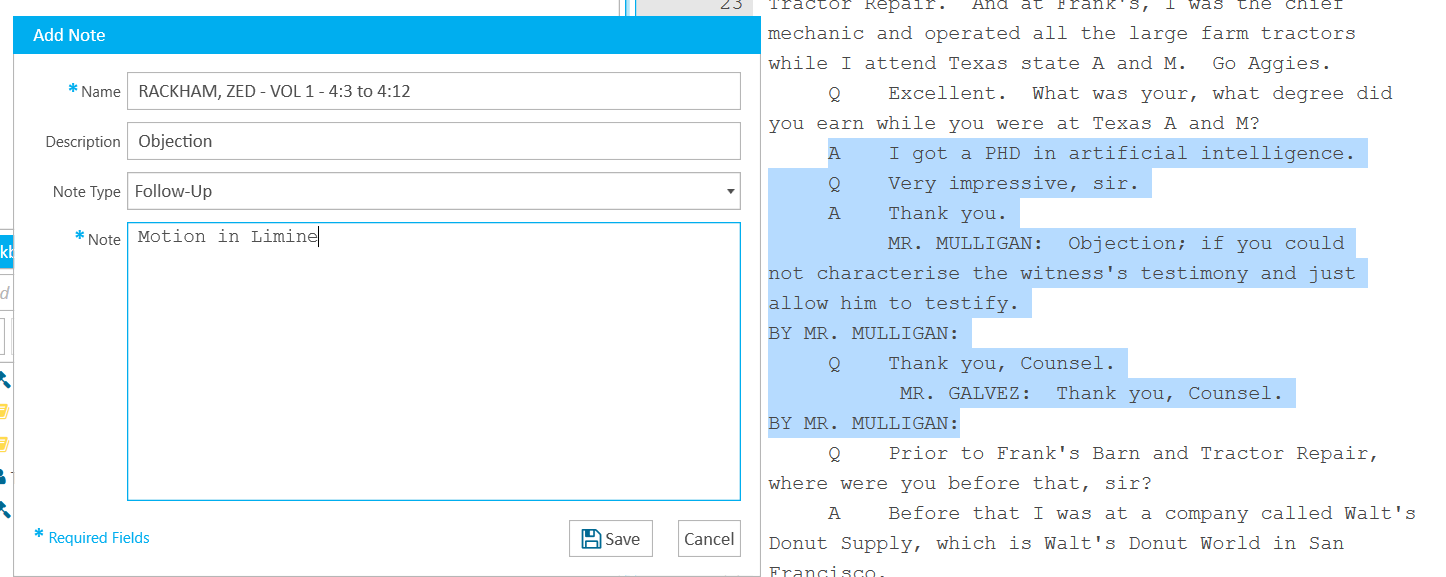
There are situations that require attornies to go “off script” if a witness's testimony takes an unexpected turn. That can require the trial presentation consultant to have to create an impeachment video clip on the fly. In such a situation, the person in the hot seat may need to conduct a word search of a transcript, identify the relevant testimony, and create a video clip.

Creating clips on the fly requires the skill to perform under pressure, but if the person conducting the trial presentation practiced, they can easily create a video clip. However, this should not be Plan A.
Being successfully able to cross-examine a witness with impeachment video clips at the ready requires preparation. The person presenting should test and retest being able to call up video deposition clips with the cross-examination outline at their side. As the saying goes, practice makes perfect.
Reveal is the provider of the two leading AI-powered eDiscovery platforms in the legal industry: Logikcull by Reveal with its self-service option, and Reveal’s enterprise-grade, feature-rich platform, both driven by the most powerful AI engine in the industry. The company has a deep history in driving the adoption of legal automation, which is underpinned by its leading processing technology, visual analytics, and artificial intelligence capabilities. Reveal's software combines technology and human guidance to transform structured and unstructured data into actionable insight. We help organizations, including law firms, corporations, government agencies, and intelligence services, uncover more useful information faster by providing a world-class user experience and AI technology that is embedded within every phase of the eDiscovery process. For more, visit revealdata.com.

.png)