Products
Use cases
Industries
Resources
Company


Legal teams handling global matters built their data residency programs around a simple assumption: pick a region, configure storage to stay inside it, and the compliance question is answered. Agentic AI breaks that assumption. ARMO's analysis of AI agent data residency under GDPR explains that an AI agent resolves tools, retrieves from corpora, and delegates to sub-agents at inference time, often crossing destinations and processors that a pre-deployment residency configuration never accounted for. Region selection was built for static systems. Agentic AI makes its own routing decisions now of inference, not at deployment.
Cross-border AI data residency in eDiscovery refers to the set of controls, deployment choices, and compliance practices legal and IT teams use to ensure that data processed by AI tools during a global matter stays within required jurisdictional boundaries, even as agentic systems make dynamic, inference-time decisions about where and how that processing happens. For global matters spanning multiple regulatory regimes, this is no longer a configuration checkbox. It is an ongoing operational requirement.
Traditional compliance models, including the EU AI Act and GDPR's Chapter V transfer regime, were written around the assumption of fixed, predetermined relationships between systems and data. The European Law Blog's analysis of agentic tool sovereignty points out that this creates a genuine regulatory gap: existing law embeds sovereignty in territory and static data residency, while agentic systems require sovereignty embedded in runtime behavior instead, since an agent can invoke tools and sub-agents that were never part of the original compliance assessment.
For eDiscovery specifically, this matters because agentic AI is increasingly used for early case assessment, review, and analysis across matters that span the EU, UK, and US at once. If the agent handling that work makes its own decisions about which model, region, or sub-process to use at inference time, a residency control set only at deployment cannot guarantee where matter data actually travels.
The EU AI Act reaches full enforcement for high-risk systems in August 2026, layering documentation, traceability, and post-market monitoring obligations on top of GDPR's existing cross-border transfer requirements. For legal teams running global matters, that means an AI tool used in eDiscovery now needs to satisfy two overlapping regimes at once: GDPR's requirement for a valid transfer mechanism whenever personal data leaves the EEA, and the AI Act's requirement for documented governance over how a high-risk system processes that data.
Demand for infrastructure that can meet both requirements is already reshaping how eDiscovery providers operate in Europe. Reveal's expansion of its partner program across EMEA, as part of its largest European investment to date, reflects exactly this shift: legal service providers and their clients need infrastructure and support built around European data residency requirements, not adapted to them after the fact.
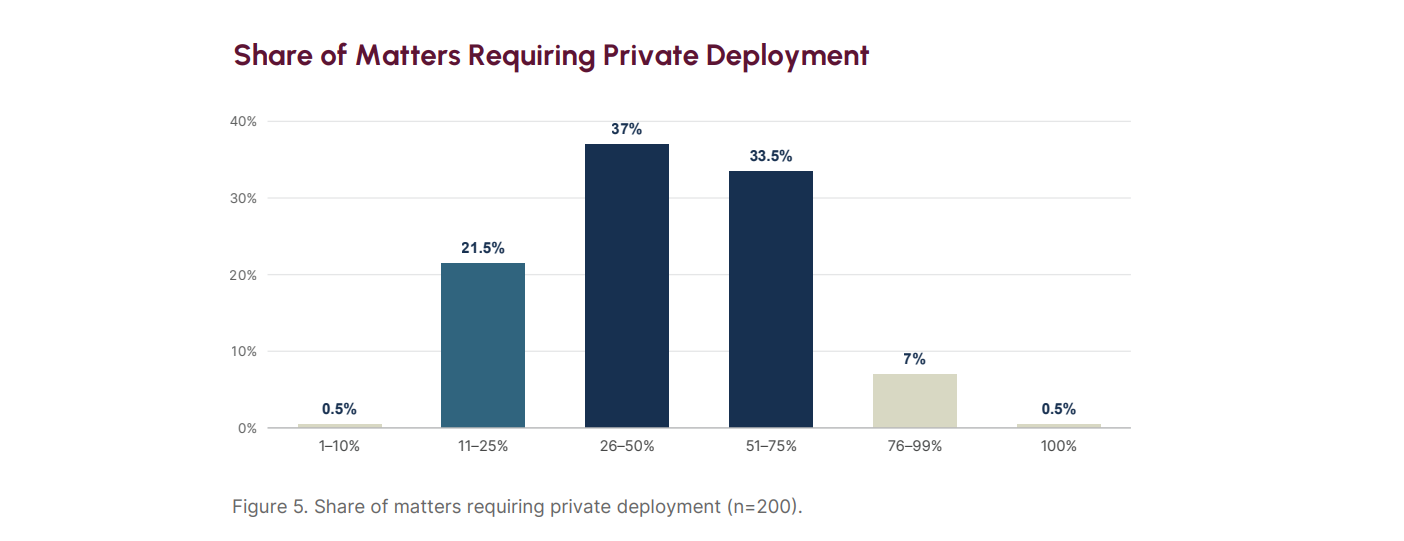
The clearest way to maintain residency control over agentic AI processing is to control where the underlying platform runs. Reveal Private Deployment allows the full platform, including its AI capabilities, to run in a customer-controlled environment, so matter data does not depend on a third-party model provider's own cross-border routing decisions.
Global matters often require moving data between deployment models as a matter's jurisdictional scope changes. Reveal's guidance on preserving deployment choice and data portability explains why a platform locked into a single hosting model creates exactly the kind of residency risk that global legal teams need to avoid, since a change in matter scope should not require a full re-platforming project.
As a global matter grows, the infrastructure supporting it needs to scale without forcing a compromise on where data lives. Reveal's analysis of what legal teams lose when on-premises eDiscovery software can't scale covers this tension directly: rigid infrastructure choices made early in a matter can become a liability precisely when data volume and jurisdictional complexity increase together.
Legal and compliance teams managing cross-border matters should build their approach around a few specific practices:
The gap between static residency controls and dynamic agentic AI behavior will only become more consequential as enforcement of the EU AI Act ramps up through 2026. Legal teams that address this now, by choosing infrastructure built around deployment flexibility rather than retrofitting compliance later, will be better positioned when regulators start asking harder questions about where AI-processed matter data goes.
If your organization is managing cross-border matters and needs a data residency strategy built for agentic AI, Reveal's team can walk through the right deployment approach for your global footprint. You can also see the platform in action by scheduling a demo.