Products
Use cases
Industries
Resources
Company


Clio serves law firms of every size. Clio Manage handles practice management: matters, billing, documents, and client communication. Clio Work adds AI on top of it through Vincent, an AI assistant that draws on each matter's own documents and Clio's built-in legal research library, so its answers are tied to the case rather than the open web. Firms use Clio Work to summarize documents, research case law, build chronologies, and produce first drafts in minutes instead of hours.
Together, Clio and Reveal give litigation teams Clio's practice management and AI drafting alongside Logikcull's purpose-built eDiscovery.
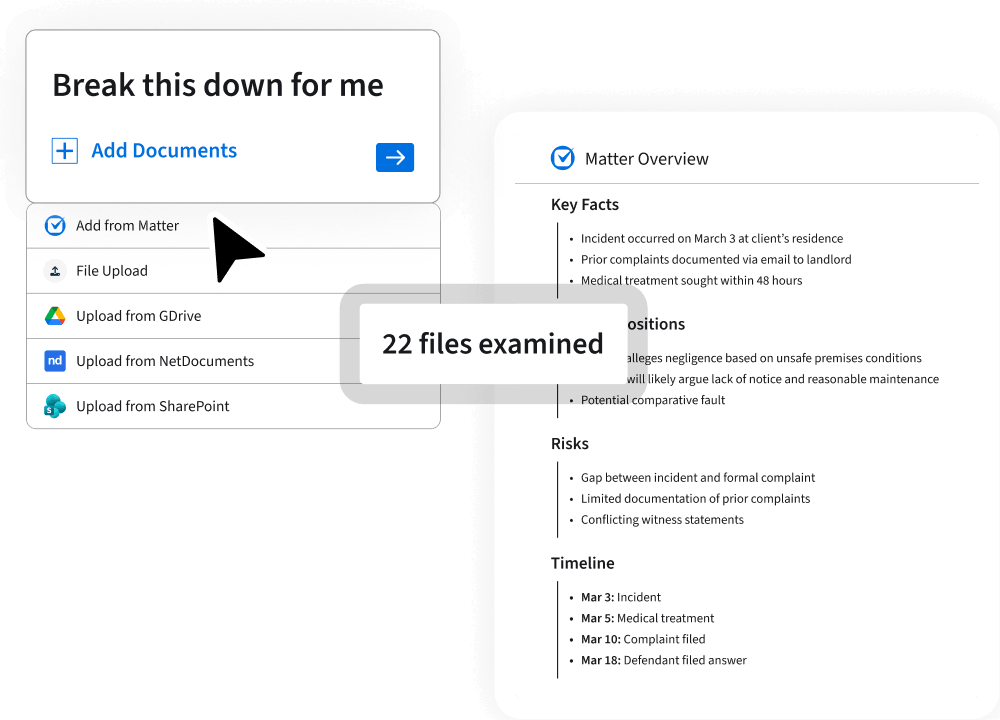
Start discovery from the matter. Connect Logikcull to Clio Manage in a few clicks. After that, every new matter you open in Clio gets a matching Logikcull project with the same name. You skip the duplicate setup, and your discovery work stays tied to the right case from day one.
Real eDiscovery, at any scale. Clio Work is built to analyze focused sets of documents, not hundreds of thousands. Logikcull handles the heavy lifting. It unpacks archives and email files, deduplicates across custodians, runs OCR, transcribes audio, and creates a forensic fingerprint of every file. Reviewers then search, tag, redact, and produce across datasets of a million documents or more.
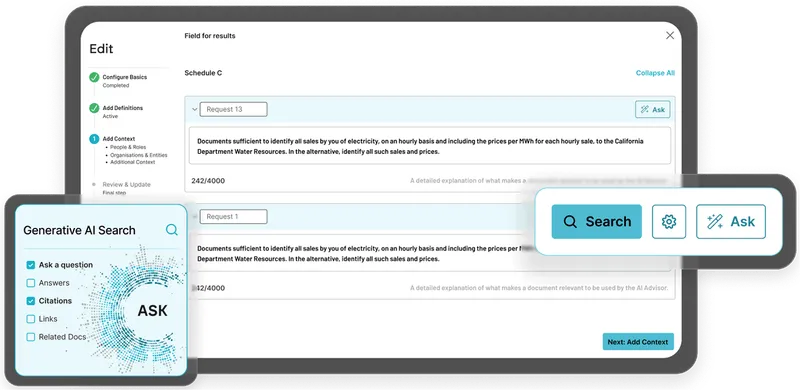
Find the key documents, then put them to work. Logikcull's filters, AI-suggested responsive and privilege tags, and Ask help you narrow a massive dataset to the documents that matter. Ask is Logikcull's AI assistant, and it answers questions using only the documents in the project. Once you have that tagged subset, Vincent in Clio Work can turn it into timelines, analysis, and drafts.
No vendor or IT team required. Even a solo practitioner can run discovery in Logikcull, with unlimited users and pricing based on data stored.
Many litigation firms ask whether an AI tool can replace eDiscovery. It can't, and it doesn't need to. Logikcull and Clio Work fit together as two halves of one workflow:
With Clio and Logikcull, firms can bring discovery in-house without outside vendors or IT support. Teams can take a matter from upload through culling, review, and production, then on to analysis and drafting. Costs stay predictable, since Logikcull licenses by data stored with unlimited users and Clio Work is a flat fee per user. Case work stays organized around the matter in Clio.



Alethea delivers innovative legal technology and digital investigation solutions that help organizations address complex discovery and forensic challenges. Their modern, technology-driven approach supports clients with efficient, scalable, and defensible outcomes across sensitive matters. Alethea pairs tailored service and a complete audit trail with Reveal software to help clients find the evidence that matters.

Amazon provides cloud computing, storage, and infrastructure services through Amazon Web Services (AWS). Its scalable and secure platform enables organizations to process, store, and analyze massive volumes of data. AWS supports mission-critical applications across industries worldwide. From complex reviews to fast, self-service discovery, Amazon relies on Reveal software for its legal data needs.

Astrea delivers strategic eDiscovery and litigation support services designed to simplify complex legal matters across the EDRM lifecycle. Their combination of technical expertise, defensible workflows, and client-focused service enables organizations to manage discovery challenges with greater efficiency and confidence. Astrea combines defensible workflows, analytics, and expert reviewers to move matters from data to decision.