Products
Use cases
Industries
Resources
Company
eDiscovery Buyers Report 2026
On average, 46% of eDiscovery matters now require private cloud or on-premise deployment, and 91% of buyers say that share has grown over the past 24 months.
While a prevailing market narrative points toward a “public cloud-first future,” in reality, almost half of all legal matters require private cloud or on-premises deployment stemming from data residency, cost, or infrastructure factors. In fact, 9 in 10 buyers report that their share of matters requiring those deployment options has increased over the last two years.
46% of matters, on average, require private deployment today
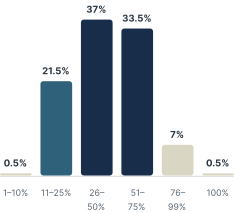
Share of matters requiring private deployment (n=200).
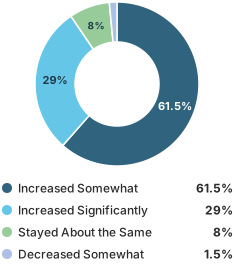
91% report an increase in the share of matters requiring private deployment
over the past 24 months
In parallel, enterprise strategy increasingly revolves around AI adoption.
60% of participants describe their AI adoption strategy as Active or Aggressive
Across industries, executives prioritize AI implementation to cut costs, scale operations, and gain competitive agility. The ability to access generative AI —particularly across frontier and proprietary models — now also dominates how buyers think about deployment.
100% say running their own proprietary or fine-tuned AI models is important
99% say access to modern AI capabilities on privately-deployed software
is important
64% say having the same access to AI for private and on-premises deployments as they do in SaaS environments is critically important or important (10% critically important, 54% important).
Further, our research indicates that buyers generally perceive private and multi-deployment eDiscovery models to be best positioned to support enterprise-scale AI adoption, driven largely by demand for flexibility in selecting and deploying AI models.
In making infrastructure decisions now, buyers seek to future-proof their legal technology investments against the rapid pace of AI innovation. Buyers want to ensure the tools they invest in today are best suited to accommodate the changes the AI revolution will continue to create.
Rather than, for instance, committing to a single vendor’s technology stack, they want
platform architecture that can evolve alongside the technology, accommodative enough to support the best AI model for a given job when considering complexity and cost. As agentic workflows mature and tomorrow’s best-in-class AI models replace today’s, organizations want the flexibility to adopt new models without overhauling their entire technology stack.
Buyers believe privately deployed architecture provides that flexibility, allowing enterprises to switch between AI models as their needs and the market evolves, and to do it at a lower total cost of ownership than public SaaS.
Chapter 3
Free Download
All the data from 200 senior buyers on AI adoption, private deployment, cost and portability, plus the ACEDS industry pulse survey.